
Custom IoT Development Services vs Off-the-Shelf Platforms: What to Choose
Introduction Businesses adopting connected technology often face an important decision: build a solution around their specific requirements or use an existing IoT platform. Off-the-shelf platforms can accelerate deployment, while custom development offers greater control over functionality, integrations, and long-term architecture. Neither option is universally better. The right choice depends on operational complexity, available resources, security requirements, and expected growth. For businesses exploring IoT development services, understanding these trade-offs is more useful than assuming customization is always superior.
1. Understanding Off-the-Shelf IoT Platforms
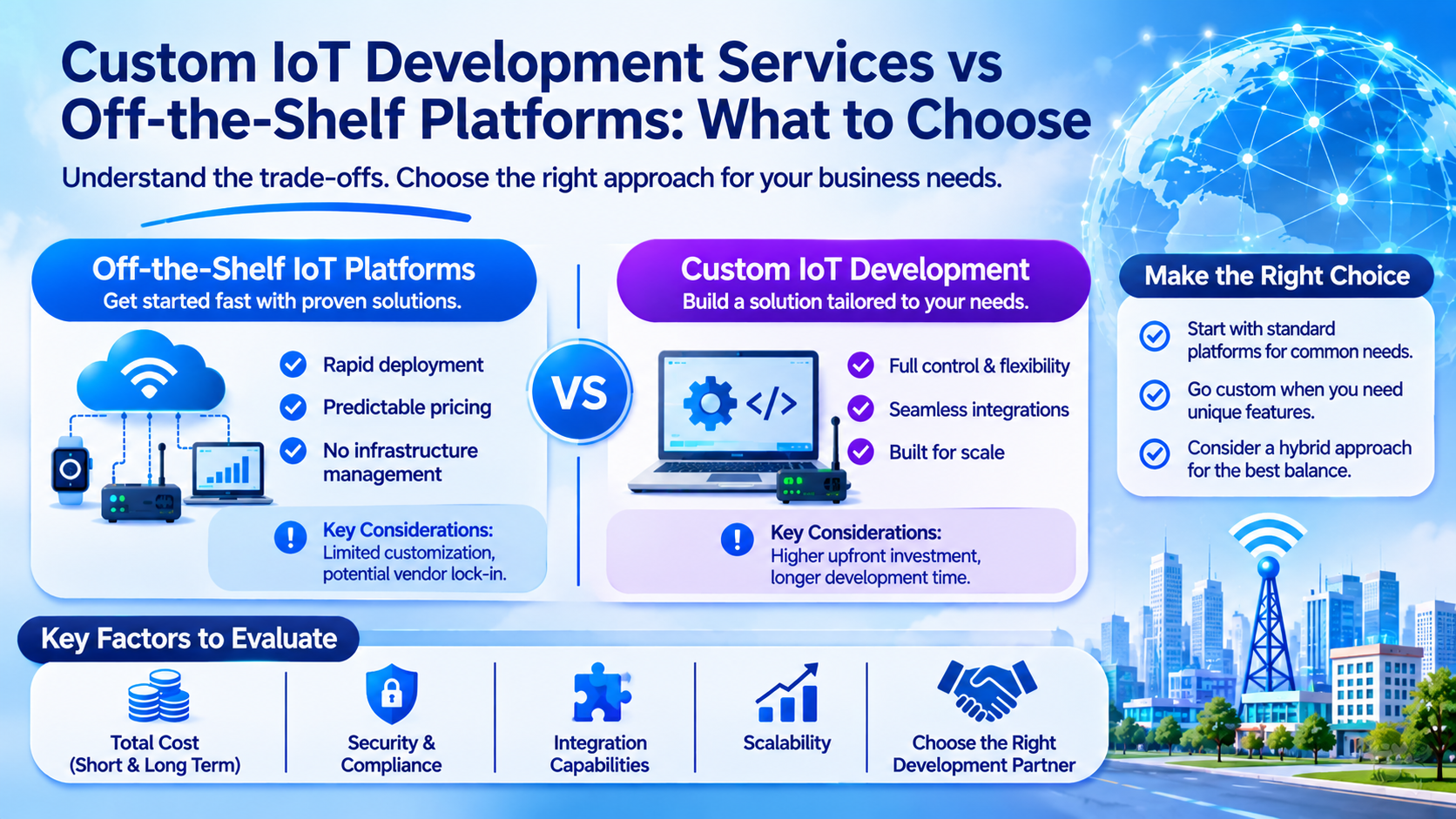
Ready-made IoT platforms typically provide device connectivity, data collection, dashboards, alerts, and device management through existing tools. Some also offer analytics, integrations, and cloud infrastructure.
Their biggest advantage is speed. Businesses can validate an idea without building every component from scratch. Subscription-based pricing may also make initial costs more predictable. However, limitations can emerge when a business needs unusual communication protocols, specialized analytics, proprietary hardware support, or deep integration with existing enterprise systems.
Vendor lock-in, usage-based fees, and restricted customization may also affect long-term costs. For standard monitoring applications, an existing platform may be entirely sufficient. Building a custom system simply to achieve minor interface changes can create unnecessary complexity.
2. When Custom IoT Development Makes Sense
Custom development becomes more attractive when operational requirements exceed what standard platforms support. Examples include industrial equipment monitoring, specialized medical devices, connected machinery, and products requiring proprietary hardware or complex data processing.
A custom solution can provide control over firmware, connectivity, APIs, user permissions, data architecture, and deployment environments. It can also make it easier to support unique workflows or integrate with legacy systems. However, customization introduces responsibilities. Businesses must account for development time, testing, security updates, documentation, infrastructure, and ongoing maintenance.
A capable IoT development company should explain which components genuinely need customization and which can be reused. The most practical approach is often hybrid: retain proven platform components while developing only the features that create a meaningful competitive or operational advantage.
3. Compare the Total Cost, Not Just the Initial Price
Off-the-shelf platforms usually reduce initial engineering effort, but recurring subscription, device, storage, and data-transfer fees can accumulate as deployment grows. Custom development generally requires greater upfront investment. Nevertheless, it may offer better control over operating costs, integrations, and product evolution when requirements are specialized or device volumes are substantial.
During IoT product development, compare costs across a realistic three-to-five-year period. Include hardware, connectivity, cloud services, development, testing, security, support, and future upgrades. Also consider the cost of changing direction. A low-cost platform can become expensive if migration requires rewriting firmware, rebuilding applications, or moving large volumes of device data.
4. Evaluate Integration, Security, and Scalability
Integration is often the deciding factor. If a platform already supports the required devices, protocols, APIs, and business applications, customization may be limited to configuration. If the product depends on proprietary hardware or specialized workflows, custom engineering may be necessary. Security deserves equal attention.
Evaluate device identity, encryption, access controls, firmware updates, vulnerability management, and data ownership. Neither a commercial platform nor a custom-built system is automatically secure; implementation and ongoing maintenance matter more than the label.
Good IoT development services should address these requirements alongside performance, interoperability, monitoring, and recovery from network failures. Test the solution with representative devices and realistic workloads before committing to a full deployment.
5. How to Evaluate a Development Partner
When requirements call for custom engineering, assess potential providers through relevant case studies, technical discussions, architecture proposals, and clearly defined deliverables. Ask who will maintain the solution after launch and whether the team has experience with your hardware, industry protocols, and integration requirements.
Businesses comparing providers in Noida, India, may consider HashStudioz as one candidate for further evaluation. Its website describes capabilities spanning connected hardware, IoT gateways, embedded development, cloud connectivity, and predictive analytics.
As checked on November 11, 2026, the HashStudioz homepage reports 100+ happy clients, 300+ dedicated developers, 10.0K+ smart devices, and 15+ countries served. Its IoT page separately reports 50+ global clients, 200+ projects delivered, 350+ IoT and software engineers, and 15+ countries served. These are company-reported figures, not independent evidence of project quality. The pages do not provide a clear publication or last-updated date, so the verification date should not be mistaken for a publication date.
The distinction matters: company-wide figures should not be merged with IoT-specific figures. The requested claims of 150+ global clients and 250+ projects delivered are not supported by the figures currently displayed on these pages. Buyers should verify relevant experience and request references before making a decision.
Conclusion
Off-the-shelf platforms are often the sensible starting point when requirements are standard and speed matters. Custom development is more compelling when hardware, integrations, security needs, or business workflows demand greater control. The strongest IoT product development strategy is not necessarily to build everything independently. It is to identify what can be reused, what must be customized, and what will remain manageable over the product's lifetime. Compare total ownership costs, validate technical assumptions through a pilot, and choose the approach that fits the real problem—not the one that sounds most advanced.
About the author
- Hi there, I am a guy who shares interest in AI, Automation and IoT Products. Nice to meet you. 🖖
Comments
Join the discussionThe point about not building a custom system just to change an interface is a fair one, and it is easy to forget when custom work is what you sell. I would add one case to the trade-offs, because it is where vendor lock-in stops being theoretical: the platform behind a device stops working while the hardware is still fine.
That happened with Actofit body-composition scales. The official app developed login errors and OTPs that never arrived, and support stopped replying, while the scales themselves still weighed perfectly well. People at Ascendra Ventures use these scales too, so we built Body Metrics, a free web dashboard, so the readings have a home again. It was a small, narrow build, one real frustration fixed properly, but it only worked because the device could still be read directly.
So for anyone choosing an off-the-shelf platform, one useful question is what happens to the devices and the data if that platform goes away. Can you still read the hardware, and can you export the history?
Do you see buyers asking about that exit path when they evaluate platforms, or does it come up only after something breaks?